info@samratrestaurant.nl
 020-624-6033


Amsterdam is one of those cities whose past doesn’t linger behind glass — it’s alive, it’s breathing, and it has a habit of jumping out at you around every street corner. But unlike cities where the past comes across as remote, in Amsterdam, you can actually walk right into it. Here, medieval churches stand alongside ancient canals, while forgotten courtyards provide moments of calm amongst the upbeat streets and neighbourhoods shaped by faith, trade and creativity continue to influence the city’s character today.
Amsterdam’s historic treasures are not to be sprinted through. It is about cruising slowly, tracing the curve of a canal and listening to church bells ringing out over rooftops; it’s about trying to get your head around how this place evolved from a small settlement by the river into one of Europe’s most influential cultural capitals.
And after a day like that—full of physical wandering but also contemplation and revelation—we all want the same thing, out-of-towners and locals alike: to sit down and be served something comforting, grounding, and memorable. Situated in the center of the city at Bethaniëndwarsstraat 17, 1012 CB Amsterdam, Samrat Restaurant is exactly that. Warm hospitality and a quiet atmosphere make it the ideal place to end your tour through Amsterdam’s past.
This guide leads you on a cultural stroll through Amsterdam’s most significant churches, canals, old streets, and neighbourhoods – concluding at the place where history meets flavour.
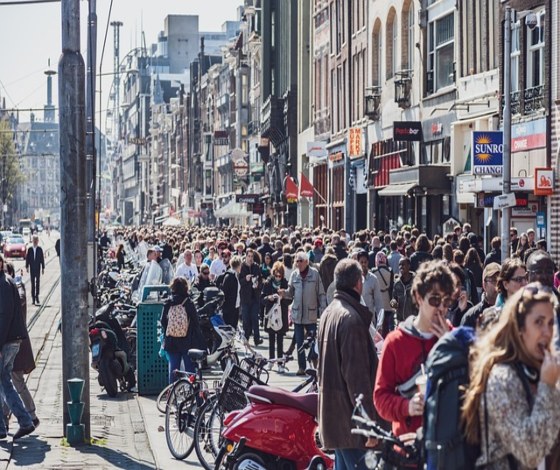
Amsterdam: A City Shaped by Faith, Trade & Tolerance
Amsterdam’s story begins with water. Built on marshy land along the Amstel River, the city was as engineered as it was populated. The canals weren’t just for show: They were necessary to live, trade and control the land. Over the course of centuries, this meticulously engineered lattice helped turn Amsterdam into one of Europe’s most efficient trading centers, with goods, people and ideas flowing freely across the city. These streams were the framework for economic prosperity, linking local craft with global trade.
Amsterdam grew into much more than a commercial city as merchants and sailors came from all over Europe, the Middle East and Asia. It was a crossroads of culture, language and religion. What really set the city apart, however, was its attitude toward tolerance. In a time when religious persecution and strife overwhelmed the rest of Europe, Amsterdam was known for its relatively great freedom of worship and expression. Jewish communities and Protestant minorities, as well as independent thinkers, all sought refuge in the vicinity of this city, which has contributed to its intellectual and cultural vibrancy.
We see this spirit of openness alive and well today. Gigmashaphram churches, synagogues and underground ex-house churches nestle alongside each other, frequently in the same districts. Their existence isn’t just a matter of religious history, however; it also speaks to a broader philosophy of coexistence that shaped daily life, the practice of governance and social norms. Instead of smudging out differences, Amsterdam learned to cohabit with them.
Walking through the city now, it’s hard to miss that layered identity: narrow streets give way to grand squares; centuries-old canal houses abut contemporary cafés and galleries. Amsterdam is such an intimate, yet intricate city; it’s historic and constantly changing. Because the city is so compact and interconnected, a day of museums, markets and canals easily slides into an evening of lounging over dinner.
At Samrat Restaurant, a visit feels less like a sideroad and more like the comprehensive take on Amsterdam’s own essence — history, culture, global kinship at the table, which is no different from what this city has given the world for hundreds of years.

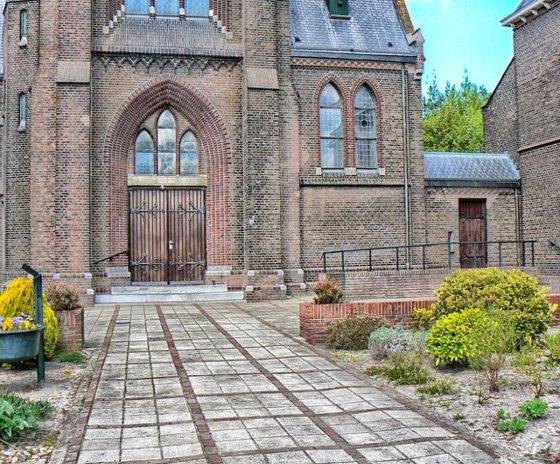
The Birth of Amsterdam: Medieval Streets & Sacred Beginnings
Old Church & Old Side Voorburgwal
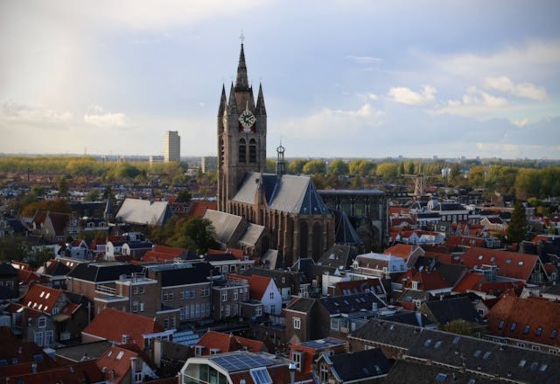
Oude Kerk is the place where Amsterdam was born and raised. Built in the early 13th century, it’s also the city’s oldest extant building and its original spiritual core. During an era when Amsterdam was little more than a frail village of fishermen, the church played a role as that special place of refuge and congregation for both fishermen and sailors, as well as the first settlers whose very lives barely differed from those on the sea.
Oude Kerk feels like time has been slowed. Heavy, wood lanterns hang in abundance from the ceiling, their timbers polished smooth across eons. Your feet are pressing down upon so many gravestones, the final resting place for ‘common’ people, merchants and even prominent figures. Muted daylight streams through stained glass windows, offering details that are poignant reminders of faith, loss and resilience. The mood is serene and meditative, a rare thing amid the city traffic outside — direct contact with Amsterdam’s earliest generations.
You emerge from the church directly onto Oudezijds Voorburgwal, one of the city’s oldest canal streets. This narrow waterway is a ghostly reminder of the original footprint of Amsterdam, where the homes, warehouses and workshops that grew up close together — not always by design so much as necessity — were eventually lost to make one striking sight for tourists. The old facades skew a bit towards the canal, talking of centuries of settlement and adaptation and survival in a city built on water.
Here, history feels near and palpable. Boats pass front doors, the reflections of buildings dance on water, and life goes by against a backdrop that has changed little for hundreds of years. Oude Kerk and Oudezijds Voorburgwal collectively contain what is most genuine about Amsterdam—the closeness of commerce, worship and everyday life in a single place, which constitutes the bedrock on top of which the city was built.
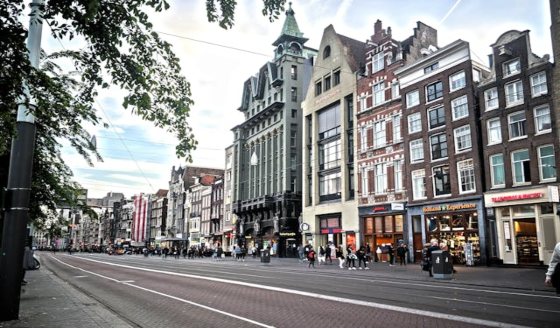
Museum Ons' Lieve Heer op Solder
But just a quick stroll away is one of the most wondrous unheralded attractions in Amsterdam: Museum Ons’ Lieve Heer op Solder. Known as “Our Lord in the Attic,” this full 17th-century canal house contains an entire Catholic church constructed across its upper floors, a quietly resolute architectural and cultural monument.
At a time when public Catholic worship was prohibited, however, Amsterdam pursued a pragmatic kind of toleration. Public churches were banned, but private worship was permitted in secret. This settlement resulted in so-called “hidden churches,” and Ons Lieve Heer op Solder is one of the best-preserved. The building is nondescript from the street, almost indistinguishable from its neighbours, and gives little away in terms of what can be found inside.
As you pass through the museum, that secret slowly unfolds. Tight staircases twist around small living spaces, kitchens and bedrooms, revealing the sort of everyday life lived by a well-to-do class of tradesmen. The space opens up onto an open, light-filled room beneath the roof as you rise. Ornate wooden galleries, an altar and meticulous details demonstrate the scale and care taken of a place meant to be hidden.
It's intimate and striking all at once. It explains how faith evolved to circumstance, and how tolerance in Amsterdam worked not through grand words, but through practical accommodation. Museum Ons’ Lieve Heer op Solder is a reminder that the city’s perception of openness was formed in (and exists alongside) lived experiences — quietly bartered, meticulously kept and stubbornly human.
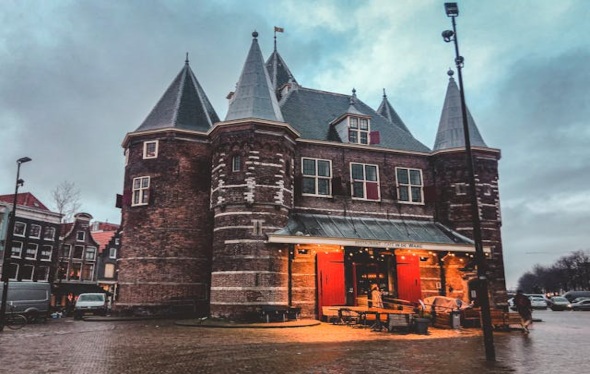
De Waag
De Waag used to stand at the northern limit of Amsterdam. It was built in the late 15th century and served as both a city gate and part of the city walls, as they surrounded the growing town. Its stout walls of river-worn stone, inlaid battlements, and solid towers are indicative of a time when security, control, and trade were inextricably linked.
As the city grew beyond its walls, De Waag’s function changed. Not being a gate anymore, it was turned into a major civic building, hosting several of the professional guilds: the surgeon's hall and that of the blacksmiths’ and merchants’. These guilds formed the heart of the early Amsterdam economy, governing trade and overseeing quality, and shaping city life. In De Waag, judgments were passed that had a significant influence on trade, public order, and the city's life.
The design of the building appears to be medieval. Outside, its fortress-like exterior suggests a lasting authority; in the near center of Nieuwmarkt, it feels like a place that really came for life. De Waag was not merely a building to be passed through; it was a space by which the city governed itself and identified its aspirations.
Today, De Waag is a powerful reminder of the importance Amsterdam places on intentional growth. It is a reminder to visitors that the city’s rise was not due to dumb luck but rather careful planning, pathbreaking efforts at urbanism, and robust civic institutions. Brick by brick, Amsterdam thus established the basis of today’s proud and well-run city.
Power, Prosperity & the Dutch Golden Age
Nieuwe Kerk, Royal Palace Amsterdam & Dam Square
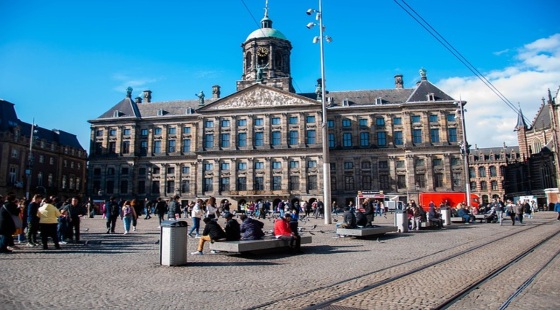
As Amsterdam’s wealth grew, thanks to trade and global power, so did its sense of civic confidence. This change is perhaps felt most acutely at Dam Square, the city’s historic heart. For centuries, this open space has served as Amsterdam’s public stage — a place for markets and political demonstrations; royal proclamations and protests; celebrations and bull baiting. Few places demonstrate the communal life of the city as pungently as this square.
Nieuwe Kerk overlooks one side of Dam Square. The church, which was constructed in the 1400's, became a venue for events of national significance such as royal coronations, state affairs and memorials. No longer used for ordinary worship services, it still serves as a ceremonial site. As a sign of Amsterdam’s long heritage, the edifice is a reminder that religion, governance and national identity were deeply entwined during the city’s ascendancy.
Next to it sits the Royal Palace Amsterdam, one of the Netherlands’ most flamboyant expressions of its Golden Age. Designed as Amsterdam’s city hall, the building was initially meant to convey authority, stability, and planetary ambition. Its classical facade, colossal scale, and sumptuous interiors were an expression of a city that considered itself not only wealthy but also a major power on the same level as Europe’s great capitals.
These two together have made Dam Square something more than a sightseer’s location. They are a product of Amsterdam when financial success meant political self-assurance and cultural sway. Being here today, in the midst of unending activity and centuries-old stone, you can feel the city’s story stretching out before you — grounded in its history but working itself out through our present.
Basilica of St. Nicholas & English Reformed Church
Nearby Central Station, the Basilica of St. Nicholas looms from above. It took shape in the 19th century, its grand façade and sumptuous interior reflecting the resurgence of Catholic worship in Amsterdam after centuries of repression. Dedicated to St Nicholas, the patron saint of sailors and travellers, the basilica is particularly meaningful in a port city that has been shaped by movement and trade. For generations, coming by water or by rail, it has been an enduring welcome and continuity.
Walk in, and the mood changes from urban hustle to stately solemnity. With high ceilings, ornate stained glass, and detailed mouldings, it’s an environment intended to inspire reflection and reverence. Relocated, and on this scale, the new basilica emphasized how perfectly openly Catholic life had come back into the public realm in this period, reflecting an important turning point in the evolving religious balance of the city.
Down the street, the English Reformed Church is a more subdued presence. Located in the Begijnhof, the church tells the story of English merchants and religious refugees who made their home in Amsterdam during the 16th and 17th centuries. Lured by economic prospects and a degree of religious freedom unmet in other European cities, they built a well-knit community whose members played major roles in the city’s commercial and cultural life.
In combination, these two churches tell a larger story. One talks through visibility and recovery, the other through silent survival. Together they speak to how Amsterdam has for centuries been moulded by international communities — each bringing their faiths, traditions and aspirations, each finding room within a city constructed on tolerance and exchange.
Quiet Refuges & Spiritual Corners
Begijnhof
Begijnhof is among Amsterdam’s most peaceful and personal corners. Tucked away behind an unremarkable door barely off the city’s vibrant streets, this courtyard unfolds into a realm marked by stillness, symmetry and moderation. The sudden juxtaposition is almost conspiratorial, as if the city is telling you to take it a little easier.
Begijnhof was historically the residence of the Beguines, devout women who never took full vows. They lived in small houses grouped around the courtyard, forming a self-sufficient community centred on prayer, charity and autonomy. This unusual way of life made Begijnhof stand out from other convents, and reflected Amsterdam’s historic acceptance of different religious practices.
And today, remarkably, the peace continues. Smart cottages, a diminutive chapel and tactful refurbishments instill a feeling of silent continuity. Begijnhof Even at the heart of a bustling capital, Begijnhof remains not a site for spectacle but a place of reflection.
After crossing Amsterdam’s bustling streets, markets and canals, stepping into Begijnhof is a precious moment of stillness. That tension — between energy and stillness, movement and rest — is part of what makes Amsterdam such a special place, and why spots like Begijnhof continue to be important in helping us understand the city’s nature.
Portuguese Synagogue
The Portuguese Synagogue is a powerful testimony to the Jewish culture in Amsterdam. Built in the 17th century, it was intended for Sephardic Jews, who fled persecution in Spain and Portugal to find one of the few places where they could openly practice their faith again in Amsterdam, and build a community.
Its architecture exudes stability and permanence. It's great, open interior is consciously devoid of too much stuff, and allows space as well as light and proportion to dictate the experience. The hall is bathed in natural light via the large windows, and hundreds of candles bring it to life during services, many that haven’t changed in hundreds of years. The lack of electric light certainly adds to an impression of continuity and reverence.
More than a house of worship, the Portuguese Synagogue is a dignity regained after centuries of exile. It’s about a community that went from hiding to being seen, from just surviving to having security. In its walls, you sense the weight of history but also the resilience of a culture that contributed to Amsterdam’s intellectual, economic and social life.
The Portuguese Synagogue continues as an active house of worship and historic monument. It is a reminder that Amsterdam’s brand as a city of tolerance was forged by concrete acts of welcome — in offering safety, opportunity and freedom to belong.
Art, Memory & Human Experience
Rembrandt House Museum
The Rembrandt House Museum provides a unique experience for visitors to travel back in time and explore the personal living space of an artist who is now considered a legend. Housed in the home where Rembrandt lived and worked for close to 20 years, the museum presents not just his art but also the environment that informed his life as an artist.
Wending their way through the rooms, visitors come across carefully crafted, reconstructed living and working spaces that reflect the daily life of a 17th-century master. The arrangement of the house, light flowing through the studio, or a highly anointed approach to furnishings all hint at how Rembrandt witnessed his surroundings and put them on canvas and paper. They convey his tools, pigments, etching equipment and the discipline and discovery that have been at work above them.
What is perhaps most compelling about the experience is its intimacy. Instead of looking at finished masterpieces in a vacuum, you see what lay behind them: the routines, the materials, and perhaps even the physical space where ideas were brought to fruition. Lived-in, human, practical, the house grounds Rembrandt’s genius in everyday life.
The Rembrandt House Museum serves to enrich an understanding of the artist by offering context for his work. It’s a message to the art world that great art doesn’t come out of thin air, but out of a specific place and a specific time and way of living — closely observed, patiently practiced, deeply connected to its physical surroundings.
Anne Frank House
The Prinsengracht is one of the most famous canals in the Amsterdam Canal Belt, a UNESCO-protected system that comprises the historic center of town. As more than just a scenic backdrop, however, those canals embody centuries of urban planning and ambition, as well as daily life fashioned around water.
Prinsengracht is more full of the human Amsterdam, feeling like it could only ever be so here. Flanked by graceful canal houses, warehouses and bridges, it used to be the haunt of merchants, craftsmen and families that made their homes and lived along the waters. In contrast to canals constructed only for show or defence, Prinsengracht was not an exercise in space as a spectacle; it was more an attempt to create a lived-in, workable matrix of commerce, private residence and community.
Taken together, the canals tell a story in layers. Some still hint at medieval boundaries and defences; others display the riches of the Dutch Golden Age through grand façades and spacious houses. In between are quieter stretches, which show the ordinariness that played out: deliveries by boat, neighbours on doorsteps and generations on the same streetscape.
To walk along these canals is to appreciate Amsterdam. The rhythm of the water, the gentle curve of the streets and a tight relationship between buildings and canals explain how it works: dense, connected, thought through. The Canal Belt is not only a historic achievement; it is the vital framework within which Amsterdam moves, breathes and reinvents itself.
Canals: The Soul of Amsterdam
Singel Canal,
Herengracht Canal,
Keizersgracht Canal,
Prinsengracht Canal
The Prinsengracht is one of the most famous canals in the Amsterdam Canal Belt, a UNESCO-protected system that comprises the historic center of town. As more than just a scenic backdrop, however, those canals embody centuries of urban planning and ambition, as well as daily life fashioned around water.
Prinsengracht is more full of the human Amsterdam, feeling like it could only ever be so here. Flanked by graceful canal houses, warehouses and bridges, it used to be the haunt of merchants, craftsmen and families that made their homes and lived along the waters. In contrast to canals constructed only for show or defence, Prinsengracht was not an exercise in space as a spectacle; it was more an attempt to create a lived-in, workable matrix of commerce, private residence and community.
Taken together, the canals tell a story in layers. Some still hint at medieval boundaries and defences; others display the riches of the Dutch Golden Age through grand façades and spacious houses. In between are quieter stretches, which show the ordinariness that played out: deliveries by boat, neighbours on doorsteps and generations on the same streetscape.
To walk along these canals is to appreciate Amsterdam. The rhythm of the water, the gentle curve of the streets and a tight relationship between buildings and canals explain how it works: dense, connected, thought through. The Canal Belt is not only a historic achievement; it is the vital framework within which Amsterdam moves, breathes and reinvents itself.
Neighbourhood Life & Local Culture
Jordaan District
The Jordaan is one of the most characterful neighbourhoods in Amsterdam. Characterized by quaint narrow streets, intimate canals and small-scale homes, Jordaan started as a working-class district that gradually became the haunt of artists and bohemians. That complex history continues to inform its atmosphere today.
Jordaan Walking through Jordaan, it’s as if the city were raising you personally — or as if people actually live here. You will be content with small art galleries and independent shops, neighbourhood cafés line residential houses in a rhythm that favours daily life over show. The region resists package-deal polish in favour of authenticity, and that’s exactly what makes it so charming.
Jordaan is also synonymous with Amsterdam’s art scene. For hundreds of years, it was the home to painters, craftsmen and musicians who were lured by affordable housing and a sense of community. That bohemian spirit lingers on in the neighbourhood’s galleries, studios and cultural spaces, a lot of them showcasing contemporary work alongside local history.
Jordaan is more than a place; it’s a neighbourhood that its residents share. Its subtle self-assurance and social intimacy, its artistic origins, are a kind of riposte to the grand monuments of Amsterdam — not city as show, but city as actually lived in and shared.
Negen Straatjes (Nine Streets),
Westerstraat & Noordermarkt
At the Westerstraat and Noordermarkt, one gets a great look at everyday Amsterdam in action. In the midst of the Jordaan, these are streets and squares that are formed more by habit than landmarks — shopping bags, talk over coffee and markets dictating the rhythm of the day.
Westerstraat cuts through the area as an eminently pragmatic lived-in street. Small shops, bakeries, cafés and neighbourhood businesses line the street, catering to residents rather than visitors. The vibe is casual and unforced, a reflection of a part of the city where daily life happens without performance.
The other end is Noordermarkt, a bustling but no-nonsense public space. The square is famous for its frequent markets on fresh produce, antiques, books and organic products. This is where locals come to shop, talk and linger, adding another layer of community that defines the neighbourhood. This sensation is further amplified by the surrounding cafés and terraces, which make the square less of a marketplace than a social meeting place.
Westerstraat (West Street) and Noordermarkt are where the real Amsterdam lies. They reveal a city that hums contentedly at human scale — where commerce, neighbourhood life and intimate social encounter align smoothly, quietly and with confidence.
Towers That Watch Over the City
Westerkerk & Westerkerk Tower
The Westerkerk is one of the most visible and recognizable churches in Amsterdam. Constructed in the 17th century at the height of the Dutch Golden Age, it symbolizes not just Amsterdam’s growing confidence and Protestant identity but also its role as a global power. Clean lines and balanced volumes rather than ornament are employed to promote clarity and restraint, reflecting the virtues of its time.
The church is overlooked by the Westerkerk Tower, the highest tower in Amsterdam. From its top floors, visitors are treated to a wide view over the canal belt, historical rooftops and nearby areas. The view also brings into sharp relief just how closely Amsterdam’s compact structure knits together history, daily life and water.
The tower is more than just a vista point – it is a visual focus within the city. An icon of Amsterdam, it has stood overlooking the city for generations. It is so close to the Anne Frank House that its symbolic meaning also grows poignant: city history, religion and memory converge in this landscape.
Between them, Westerkerk and its tower are Amsterdam boiled down to its purest form — unapologetic in structure, planted in the past and offering a view that allows visitors to see the city both
Zuiderkerk & Munttoren
The Zuiderkerk was one of the first purpose-built Protestant churches in Amsterdam, built in the early 17th century as the city rapidly expanded outside its medieval heart. Its tower was functional in urban terms, standing above the surrounding rooftops as a visual point of reference in a city where streets meandered around canals rather than being laid out on a grid. For inhabitants and visitors alike, the Zuiderkerk lent coherence to a swelling, ever more complex cityscape.
The church was built according to the principles of order and clarity, which were also held in high esteem during the Dutch Golden Age. Apart from religious functions, it’s also visible and seen, helping to express the sense that the city is ordered and legible because it has been planned. From this viewpoint, the connection between canals and neighbourhoods and public space is instantly clear.
Close by, the Munttoren fulfilled a different yet no less vital role. The tower was part of the medieval city gate, and served as a mint, thereafter becoming used as a clock tower. With its iconic clock face and bells, the tower served as a timekeeper for merchants, workers and traders passing through one of Amsterdam’s busiest districts.
The Zuiderkerk and the Munttoren together exemplify how architecture was a force that shaped movement and rhythm within this city. They weren’t simply landmarks to gaze upon, but practical instruments — they helped residents situate themselves in space and time. They offered reassurance, structure and a shared understanding of the world in a city that was organized by water, trade and relentless grinding energy — forces that still insinuate themselves into our experience.
Ending Your Historic Walk at Samrat Restaurant
At the end of a day enriched by walking, contemplation and abointment, Samrat Indian Restaurant offers a warm place to rest. The Center of Everything. It is easily accessible from all parts of the City, and with so many places to explore and relax, you can let your exploration turn into rest without leaving.
The atmosphere inside is calm and welcoming. There’s warm lighting, the service is solicitous, and there are layers of Indian spice in the air that provide comfort in direct contrast to the harried pace outside. The environment invites you to take a seat, relax, and for things to slow down a bit.
You'll find authentic Indian cuisine that is both flavoursome and completely substance-driven (ideal after a few hours pounding the historic streets of Amsterdam). The dishes are designed to share, making the table a space for stories to converge, much like the food itself.
And to end a historic walk at this Indian Restaurant is a righting of the cosmic scales. After having had it out with the city’s past and present, dinner becomes a connecting zone of ease — rounding off the day in an absolutely unmistakable way, full of care and consideration — really quite unforgettable.
A Complete Amsterdam Experience
Exploring Amsterdam’s historical landmarks is not just sightseeing but a journey through centuries of faith, artistry, trade and determination. From secret sites of worship and canalside quarters to civic landmarks and hidden courtyards, the city unfurls layer by layer - each site furnishing a piece in the jigsaw puzzle of its personality.
What makes this voyage feel satisfying is balance. After hours on your feet, looking and thinking, it’s only human to feel that the experience requires somewhere to stop. The day’s final stop: Samrat Indian Restaurant, a place that perfectly straddles those respective goals of getting the history and giving way to relaxation and conversation.
This Indian Restaurant is set in the centre of town and provides a peaceful and relaxed environment to relax in. A convivial, welcoming place with good Indian food and warm service, the Lal Qila is a great spot for a suitably satisfying end to a day of maximum discovery. The meal isn't just a dinner; it's an opportunity to sit, reflect on the day and share impressions, all while letting your Amsterdam experiences digest.
When you’re experiencing Holland’s history, make sure to end your day where taste and heat meet! A historical stroll through the city is most aptly concluded at Samrat Restaurant — a considered and complete experience that is haunting.